


Chevy Colorado MPG — Fuel Economy by Trim
Chevy Colorado MPG — Fuel Economy by Trim
The 2026 Chevrolet Colorado delivers impressive fuel economy for a midsize pickup truck, with EPA ratings ranging from 17 MPG city to 24 MPG highway depending on configuration. At Champion Chevrolet in La Grange, KY, we help drivers understand how different trim levels and drivetrain options affect real-world gas mileage.
Whether you’re commuting through La Grange or hauling equipment to job sites across Kentucky, understanding Chevy Colorado fuel efficiency helps you make an informed decision. The 2026 model year features a turbocharged 2.7L four-cylinder engine across all trims, paired with an eight-speed automatic transmission that optimizes shift points for better fuel economy. Our team at Champion Chevrolet can walk you through the complete inventory to find the configuration that matches your efficiency needs.
Key Highlight
The 2026 Chevy Colorado 2WD achieves up to 24 MPG highway, making it one of the most fuel-efficient midsize trucks in its class while maintaining a towing capacity of up to 7,700 pounds.
This comprehensive guide breaks down Chevy Colorado MPG ratings by trim level, explores factors that impact fuel economy, and provides practical tips for maximizing efficiency. We’ll compare city and highway driving performance, examine how four-wheel drive affects gas mileage, and show you how the Colorado stacks up against competitors in the midsize truck segment.
Key Takeaways
- The 2026 Chevy Colorado achieves 19 city / 24 highway MPG in 2WD configuration and 17 city / 22 highway MPG with 4WD
- All Colorado trims use the same 2.7L TurboMax engine, so drivetrain choice has the biggest impact on fuel economy
- The ZR2 off-road trim achieves 17 city / 17 highway MPG due to larger tires and specialized suspension
- Proper maintenance and driving habits can improve real-world MPG by 10-15% compared to EPA estimates
- Champion Chevrolet in La Grange offers expert guidance on selecting the most fuel-efficient Colorado configuration for your needs
2026 Chevy Colorado MPG Ratings by Trim Level
The 2026 Chevrolet Colorado lineup features consistent engine specifications across all trim levels, with fuel economy differences primarily determined by drivetrain configuration and tire size. Every Colorado is powered by a 2.7L turbocharged four-cylinder engine producing 310 horsepower and 430 lb-ft of torque, paired with an eight-speed automatic transmission designed to maximize efficiency during highway cruising.
According to EPA testing data, the base rear-wheel-drive Colorado achieves the best fuel economy numbers in the lineup. When you upgrade to four-wheel drive, the additional weight and drivetrain components reduce efficiency by approximately 2 MPG in both city and highway driving. The off-road-focused ZR2 trim sees further reductions due to its 33-inch all-terrain tires, lifted suspension, and additional underbody protection.
2WD Configuration
19 city / 24 highway / 21 combined MPG — Best choice for drivers prioritizing fuel economy who don’t need off-road capability
4WD Configuration
17 city / 22 highway / 19 combined MPG — Balanced option for all-weather capability with minimal efficiency penalty
ZR2 Off-Road
17 city / 17 highway / 17 combined MPG — Specialized configuration optimized for extreme terrain rather than fuel economy
At Champion Chevrolet, we help La Grange drivers understand that trim level names like WT, LT, Trail Boss, and Z71 don’t directly affect MPG when comparing similar drivetrain configurations. The real fuel economy differences come from choosing between 2WD and 4WD, and whether you opt for the specialized ZR2 package. Visit our showroom to compare configurations side-by-side and determine which setup best matches your driving patterns.
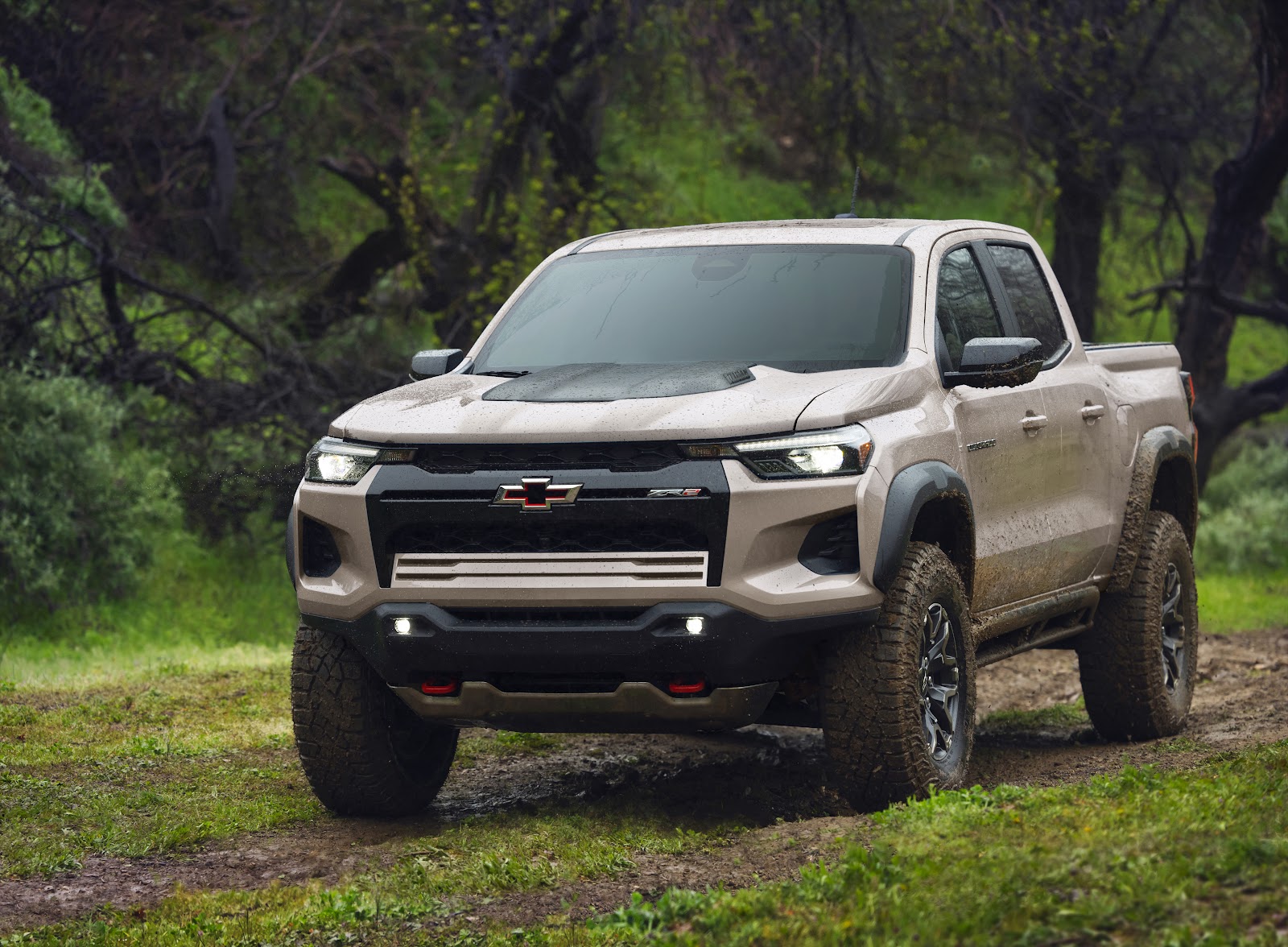
The 2026 Chevy Colorado’s aerodynamic design contributes to its impressive highway fuel economy ratings
Chevy Colorado Fuel Economy Comparison: City vs Highway Driving
Understanding the difference between city and highway MPG helps La Grange drivers predict real-world fuel costs based on their typical driving patterns. The Colorado shows a significant efficiency advantage during highway driving, where the turbocharged engine operates in its optimal RPM range and the eight-speed transmission keeps engine speed low during cruising.
| Configuration | City MPG | Highway MPG | Combined MPG |
|---|---|---|---|
| 2WD (WT, LT) | 19 | 24 | 21 |
| 4WD (WT, LT, Trail Boss, Z71) | 17 | 22 | 19 |
| 4WD with Mud Terrain Tires | 17 | 20 | 18 |
| ZR2 / ZR2 Bison | 17 | 17 | 17 |
Why Highway Driving Improves Fuel Economy
The Colorado’s turbocharged engine delivers peak torque at low RPMs, which means it doesn’t need to work as hard during steady-speed highway cruising. The eight-speed automatic transmission features tall overdrive gears that keep engine speed around 1,800-2,000 RPM at 70 MPH, significantly reducing fuel consumption compared to city driving with frequent acceleration and braking. This design philosophy makes the Colorado particularly efficient for drivers who spend significant time on Kentucky highways and interstates.
City Driving Efficiency Factors
Urban driving in La Grange involves more stop-and-go traffic, which requires the engine to work harder during acceleration phases. The Colorado’s auto start-stop system (standard on most trims) helps reduce fuel consumption at traffic lights by shutting off the engine when the vehicle is stationary. However, the added weight of four-wheel-drive components and larger tires on off-road trims creates more rolling resistance, which becomes more noticeable during frequent acceleration in city conditions.
What La Grange Drivers Should Know About Factors Affecting Chevy Colorado MPG
Real-world fuel economy often differs from EPA estimates based on driving habits, maintenance practices, and environmental conditions. At Champion Chevrolet, we educate customers about the variables that impact their Colorado’s gas mileage so they can maximize efficiency in everyday driving around La Grange and beyond.
Driving Habits and Techniques
Aggressive acceleration and hard braking can reduce fuel economy by up to 33% on the highway and 5% in city driving, according to Department of Energy data. The Colorado’s turbocharged engine responds well to smooth, gradual throttle inputs that allow the transmission to upshift earlier and keep the engine in its most efficient operating range. Using cruise control on highways maintains consistent speed and prevents the small throttle variations that waste fuel. Our service team at Champion Chevrolet can demonstrate optimal driving techniques during your test drive.
Maintenance Impact on Fuel Efficiency
Proper maintenance directly affects Colorado fuel economy. Under-inflated tires increase rolling resistance and can reduce MPG by 0.2% for every 1 PSI drop in pressure. The Colorado’s recommended tire pressure is 35 PSI for most configurations, and checking monthly helps maintain optimal efficiency. Dirty air filters restrict airflow to the engine, forcing it to work harder and consume more fuel. Using the manufacturer-recommended 5W-30 synthetic oil reduces internal friction and improves efficiency by 1-2% compared to conventional oil.
Payload and Towing Considerations
Adding cargo weight or towing a trailer significantly impacts fuel economy. Every 100 pounds of additional weight reduces MPG by approximately 1% in most vehicles. When towing near the Colorado’s maximum capacity of 7,700 pounds, expect fuel economy to drop by 30-50% depending on trailer aerodynamics and terrain. The Colorado’s Tow/Haul mode adjusts transmission shift points and throttle response to optimize efficiency when hauling heavy loads, though overall consumption will still increase compared to unloaded driving.
Chevy Colorado Engine Specifications and Fuel Economy Technology
The 2026 Colorado’s 2.7L TurboMax engine represents Chevrolet’s latest approach to balancing power and efficiency in the midsize truck segment. This turbocharged four-cylinder engine uses advanced technologies to deliver V6-level performance with improved fuel economy compared to larger displacement engines.
TurboMax Engine Technology
The 2.7L engine features a twin-scroll turbocharger that reduces lag and improves throttle response while maintaining efficiency. Variable valve timing on both intake and exhaust camshafts optimizes combustion across the RPM range, allowing the engine to produce 310 horsepower and 430 lb-ft of torque while achieving competitive fuel economy. Direct fuel injection delivers precise fuel metering, reducing waste and improving combustion efficiency. The engine’s aluminum block construction reduces weight compared to iron blocks, contributing to better overall vehicle efficiency.
Transmission and Drivetrain Efficiency
The eight-speed automatic transmission uses closely spaced gear ratios in lower gears for responsive acceleration, then switches to wide-ratio overdrive gears for highway cruising. Electronic transmission control continuously monitors driving conditions and adjusts shift points to balance performance and efficiency. When equipped with four-wheel drive, the Colorado uses an electronically controlled transfer case that allows drivers to switch between 2WD and 4WD modes, enabling 2WD operation during normal driving to maximize fuel economy.
| Specification | Details | Efficiency Benefit |
|---|---|---|
| Engine Type | 2.7L Turbocharged I-4 | Smaller displacement than V6 competitors |
| Horsepower | 310 hp @ 5,600 RPM | Adequate power without oversizing |
| Torque | 430 lb-ft @ 3,000 RPM | Low-RPM torque reduces fuel consumption |
| Transmission | 8-Speed Automatic | Optimized gear ratios for efficiency |
| Auto Start-Stop | Standard (most trims) | Reduces idle fuel consumption |
These engineering choices allow the Colorado to compete effectively with both four-cylinder and V6-powered midsize trucks. The combination of turbocharging and modern transmission technology delivers the performance drivers expect from a capable truck while maintaining fuel economy that reduces operating costs over the vehicle’s lifetime.

The Colorado’s digital instrument cluster provides real-time fuel economy monitoring to help drivers optimize efficiency
Chevy Colorado MPG Comparison: How It Stacks Up Against Competitors
When shopping for a midsize truck in La Grange, comparing fuel economy across competing models helps you understand the Colorado’s efficiency advantage. The 2026 Colorado competes directly with the Toyota Tacoma, Ford Ranger, and Nissan Frontier in the midsize truck segment, each offering different approaches to balancing capability and fuel economy.
Midsize Truck Fuel Economy Comparison
The Colorado’s turbocharged four-cylinder engine delivers competitive fuel economy while maintaining strong towing and payload capabilities. The Ford Ranger with its 2.3L EcoBoost engine achieves similar numbers (20 city / 24 highway MPG in 2WD), while the Toyota Tacoma with its 2.4L turbo engine rates at 19 city / 24 highway MPG. The Nissan Frontier’s naturally aspirated V6 achieves 18 city / 24 highway MPG, showing the efficiency advantage of modern turbocharged engines.
| Model | Engine | City MPG (2WD) | Highway MPG (2WD) |
|---|---|---|---|
| 2026 Chevy Colorado | 2.7L Turbo I-4 | 19 | 24 |
| 2026 Ford Ranger | 2.3L Turbo I-4 | 20 | 24 |
| 2026 Toyota Tacoma | 2.4L Turbo I-4 | 19 | 24 |
| 2026 Nissan Frontier | 3.8L V6 | 18 | 24 |
The Colorado’s advantage becomes more apparent when comparing towing capacity relative to fuel economy. With a maximum towing capacity of 7,700 pounds, the Colorado matches or exceeds most competitors while maintaining competitive MPG ratings. This balance makes it an excellent choice for drivers who need occasional towing capability without sacrificing daily driving efficiency.
Real-World Efficiency in Kentucky Driving Conditions
EPA estimates provide standardized comparisons, but real-world driving in Kentucky involves varied terrain, weather conditions, and driving patterns. The Colorado’s turbocharged engine performs particularly well in hilly terrain around La Grange, where the low-end torque allows the engine to maintain speed without downshifting as frequently as naturally aspirated competitors. During winter months, the auto start-stop system can be disabled if desired, though this reduces city fuel economy by approximately 5-7%. Our team at Champion Chevrolet can provide insights based on feedback from local Colorado owners about real-world fuel economy in typical Kentucky driving conditions. Call us at (502) 265-5066 to discuss your specific driving needs.
Experience Chevy Colorado Fuel Efficiency at Champion Chevrolet in La Grange
Understanding MPG ratings on paper is valuable, but experiencing the 2026 Chevrolet Colorado’s real-world fuel efficiency firsthand helps you make a confident decision. At Champion Chevrolet, located at 502 S 1st St in La Grange, KY, our knowledgeable sales team can arrange test drives in multiple Colorado configurations so you can compare 2WD and 4WD fuel economy in actual driving conditions around La Grange and the surrounding area.
Our service department provides expert maintenance to help you maximize your Colorado’s fuel efficiency throughout ownership. From tire pressure monitoring and air filter replacements to transmission service and engine tune-ups, we offer comprehensive care that keeps your truck running at peak efficiency. We also stock genuine Chevrolet accessories like tonneau covers and aerodynamic bed caps that can improve highway fuel economy by reducing wind resistance.
Whether you’re interested in the fuel-efficient 2WD LT for daily commuting or the capable 4WD Z71 for weekend adventures, Champion Chevrolet has the expertise to match you with the right Colorado configuration. Visit our showroom to explore our current inventory, discuss financing options, and learn how the Colorado’s fuel economy translates to long-term savings. Contact us today at (502) 265-5066 to schedule your test drive and discover why La Grange drivers trust Champion Chevrolet for their truck needs.
People Also Ask
What is the MPG of the 2026 Chevy Colorado?
The 2026 Chevy Colorado achieves 19 city / 24 highway / 21 combined MPG in 2WD configuration and 17 city / 22 highway / 19 combined MPG with 4WD. The off-road ZR2 trim rates at 17 city / 17 highway / 17 combined MPG due to larger tires and specialized suspension. All trims use the same 2.7L turbocharged four-cylinder engine producing 310 horsepower and 430 lb-ft of torque.
Which Chevy Colorado trim has the best fuel economy?
The 2WD Chevy Colorado in WT or LT trim delivers the best fuel economy at 19 city / 24 highway MPG. Trim level names don’t directly affect MPG when comparing similar drivetrain configurations—the primary fuel economy difference comes from choosing 2WD versus 4WD. The ZR2 off-road trim has the lowest fuel economy at 17 combined MPG due to its 33-inch all-terrain tires, lifted suspension, and additional weight from off-road equipment.
How does the Chevy Colorado compare to other trucks in MPG?
The 2026 Chevy Colorado’s 19 city / 24 highway MPG (2WD) is competitive with midsize truck rivals including the Ford Ranger (20/24 MPG), Toyota Tacoma (19/24 MPG), and Nissan Frontier (18/24 MPG). The Colorado’s turbocharged 2.7L engine delivers this efficiency while maintaining a maximum towing capacity of 7,700 pounds, matching or exceeding most competitors. Its combination of fuel economy and capability makes it a strong choice in the midsize truck segment.
What factors affect the MPG of a Chevy Colorado?
Chevy Colorado fuel economy is affected by drivetrain choice (2WD vs 4WD), tire size, payload weight, towing load, driving habits, and maintenance. Aggressive acceleration can reduce MPG by up to 33%, while under-inflated tires decrease efficiency by 0.2% per PSI below recommended pressure. Towing near maximum capacity can reduce fuel economy by 30-50%. Proper maintenance including clean air filters, correct tire pressure, and synthetic oil helps maximize efficiency.
Can I improve the MPG of my Chevy Colorado?
Yes, you can improve Chevy Colorado MPG by 10-15% through proper maintenance and driving techniques. Maintain correct tire pressure (35 PSI for most configurations), use smooth acceleration and braking, utilize cruise control on highways, and remove unnecessary cargo weight. Replace air filters regularly, use manufacturer-recommended 5W-30 synthetic oil, and consider aerodynamic accessories like tonneau covers. The Colorado’s auto start-stop system also reduces fuel consumption during city driving when enabled.
Where can I test drive a Chevy Colorado near La Grange, KY?
Champion Chevrolet in La Grange, KY offers test drives of the 2026 Chevy Colorado in multiple configurations including 2WD and 4WD models. Located at 502 S 1st St, La Grange, KY 40031, our dealership allows you to experience real-world fuel efficiency in local driving conditions. Our sales team can arrange back-to-back test drives of different trim levels so you can compare fuel economy and performance. Call (502) 265-5066 to schedule your test drive today.
0 comment(s) so far on Chevy Colorado MPG — Fuel Economy by Trim